
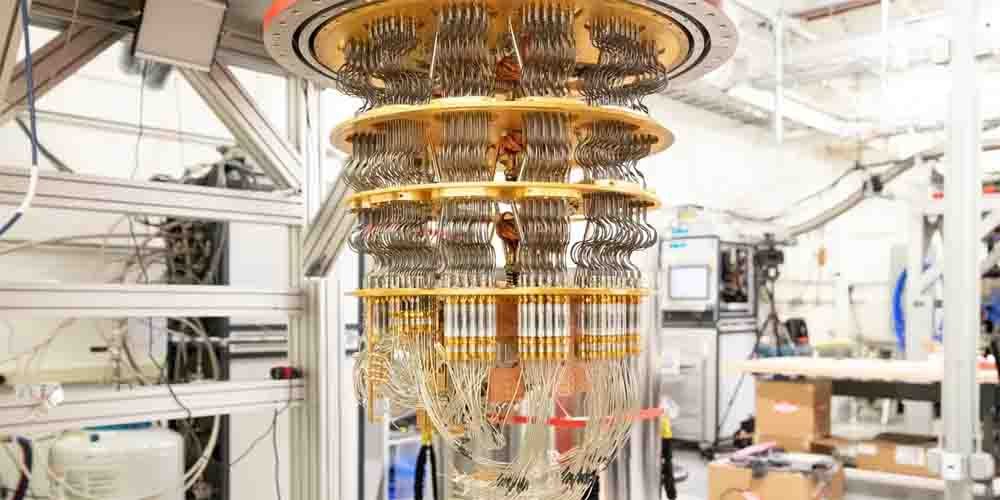

In October 2019, Google made
headlines in the scientific community when it announced a major breakthrough in
quantum computing. Its state-of-the-art quantum computer, Sycamore, achieved a
milestone known as “quantum supremacy.” This groundbreaking achievement
marked a significant leap forward in the world of computing, promising to
revolutionize various industries and scientific fields. In this article, we
delve into the fascinating world of Google’s Sycamore and explore the potential
impact of quantum supremacy.
Understanding Quantum Supremacy
Quantum supremacy refers to a
moment when a quantum computer performs a specific task exponentially faster
than even the most advanced classical supercomputers. The concept hinges on
harnessing the principles of quantum mechanics, a branch of physics that
explores the behavior of matter and energy at the atomic and subatomic levels.
Unlike classical computers, which
use bits to store and process information as 0s and 1s, quantum computers
utilize quantum bits or qubits. Qubits can exist in multiple states
simultaneously, thanks to the phenomenon known as superposition. Additionally,
they can be entangled, meaning the state of one qubit is dependent on the state
of another, even if separated by vast distances.
Google’s Quantum Leap: The
Sycamore Processor
Google’s Sycamore is an advanced
quantum processor built to demonstrate quantum supremacy. It consists of 54
qubits, each represented by tiny circuits known as superconducting loops. These
qubits are cooled to near absolute zero temperatures to prevent any
interference from the outside environment, a requirement for maintaining their
delicate quantum state.
Sycamore’s breakthrough moment
came when it solved a specific mathematical problem in just over 200 seconds—a task
that would take the world’s most advanced classical supercomputers thousands of
years to complete. This quantum computational power showcased the potential of
quantum computing to transform how we approach complex problems and
simulations.
Potential Applications of Quantum
Supremacy
Quantum supremacy opens up a
world of possibilities for solving complex problems that have been beyond the
reach of classical computing capabilities. Some potential applications include:
1. Drug Discovery and Material Science:
Quantum computers could revolutionize the process of discovering new drugs and
materials by efficiently simulating molecular interactions and properties,
dramatically accelerating research in these fields.
2. Cryptography and Cyber
security: Quantum computers have the potential to crack some of the most
sophisticated encryption algorithms currently in use. However, they can also
lead to the development of quantum-resistant cryptographic techniques,
bolstering cyber security in the quantum era.
3. Optimization Problems: Quantum
computers excel at solving optimization problems, such as logistics, supply
chain management, and financial modeling, leading to more efficient solutions
and cost savings.
4. Climate Modeling: Quantum
simulations can improve climate modeling and help researchers gain a deeper
understanding of climate change, enabling better predictions and informed
decision-making.
Challenges on the Path to Quantum
Supremacy
While Google’s achievement with
Sycamore is remarkable, quantum supremacy is just the beginning of the quantum
computing journey. Several challenges remain on the path to harnessing the full
potential of quantum computing:
1. Error Correction: Quantum computers
are highly sensitive to noise and errors, which can quickly propagate through
quantum circuits. Error correction techniques are essential to maintaining the
integrity of quantum computations.
2. Scalability: Building
large-scale quantum processors with a significant number of qubits is a
formidable engineering challenge. Scaling quantum systems while preserving
qubit coherence is crucial for tackling more complex problems.
3. Quantum Algorithms: Developing
efficient quantum algorithms optimized for different applications is an ongoing
area of research. The challenge lies in determining the best approach to
leverage quantum capabilities for specific tasks.
4. Quantum Hardware and
Stability: Quantum computers require extremely low temperatures and precise
control to maintain qubit coherence. Achieving stability and fault-tolerance in
quantum hardware is vital for practical applications.
As researchers and engineers
continue to address the challenges of error correction, scalability, and
quantum algorithms, we can expect quantum computing to play an increasingly
prominent role in shaping the future of technology and scientific exploration.
Quantum supremacy is just the beginning—exciting developments and applications
lie ahead as we unlock the full power of quantum computing.